
Search Glascock County Court Records
Glascock County does not publish a county-branded public case search portal for Superior, Juvenile, Probate, Magistrate, traffic, criminal, civil, or warrant records. The strongest official path is to identify the court first, then contact the office that holds the file. The Glascock County Clerk of Superior Court handles Superior and Juvenile filings, while the Probate and Magistrate Courts office handles probate, marriage, vital, misdemeanor traffic, small-claims, warrant, and county ordinance matters.
The online tools that do exist are narrower. GSCCCA search helps with real estate, UCC, lien, plat, PT-61, notary, and certified-search paths. PeachCourt is used for mandatory civil e-filing, not as a free local public case database. The Georgia Courts E-Access page redirects users to provider sites and may require accounts; Glascock County was not found in the inspected visible provider links.
- Identify whether the record is Superior, Juvenile, Probate, Magistrate, traffic, sheriff, or federal.
- Use GSCCCA first for land, lien, UCC, plat, PT-61, notary, and certified-search needs.
- Call the proper Glascock County office before traveling, especially on Wednesdays or for sealed files.
- Send mail requests with party names, case type, filing date range, case number if known, and copy type.
- Use Georgia Open Records Act wording for sheriff, jail, incident, booking, or administrative records.
For a practical starting point, the official county homepage links to county departments and notices that affect Glascock County court records work.
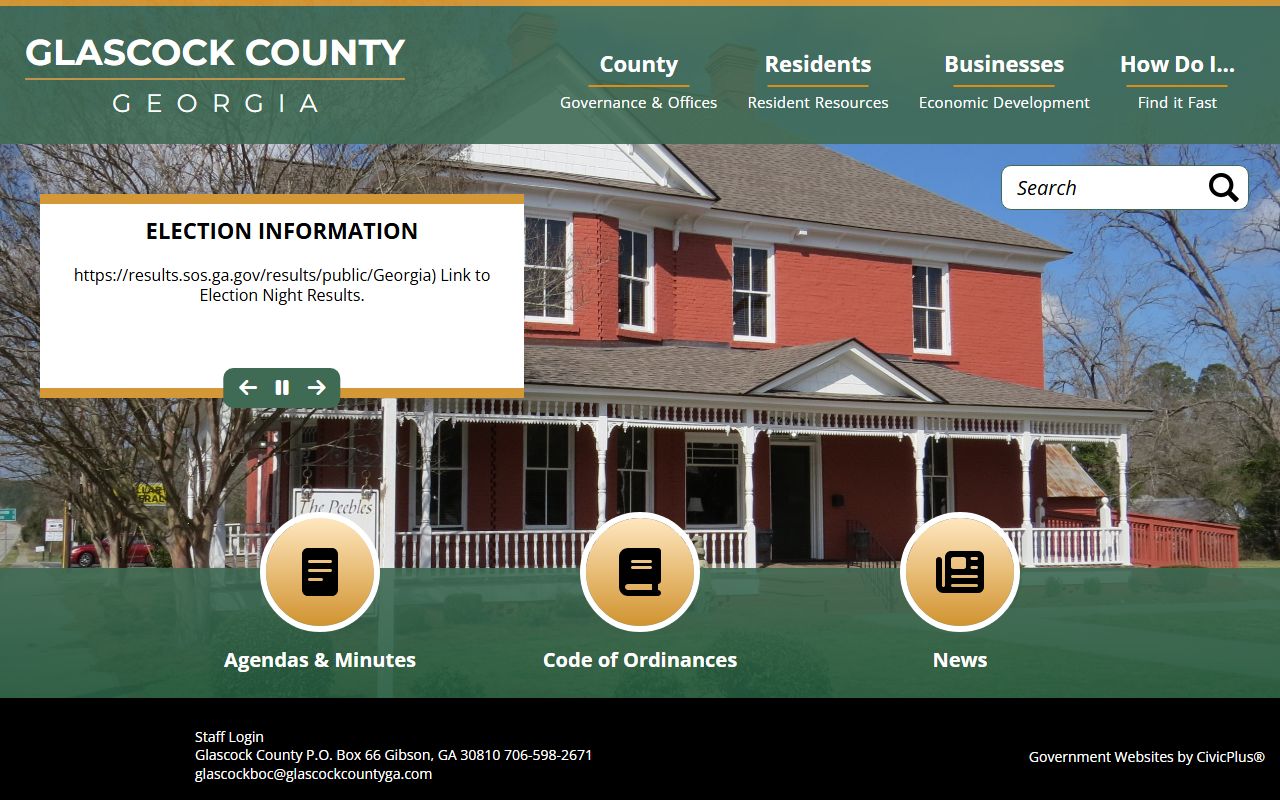
The county site is useful because it points readers to the court, sheriff, directory, and public notice pages used when a local search portal is not available.
Glascock County Court System
Georgia uses Superior Court as the main trial court of general jurisdiction. Glascock County is part of the Toombs Judicial Circuit, which also serves Lincoln, McDuffie, Taliaferro, Warren, and Wilkes Counties. The county has Superior, Juvenile, Probate, and Magistrate Court functions, while a separate local State Court page was not found. Municipal court access depends on whether a city maintains a court or routes matters to county offices.
The Council of Superior Court Judges explains the difference between Georgia trial courts, and that structure matters in Glascock County because the record custodian changes with the case type.
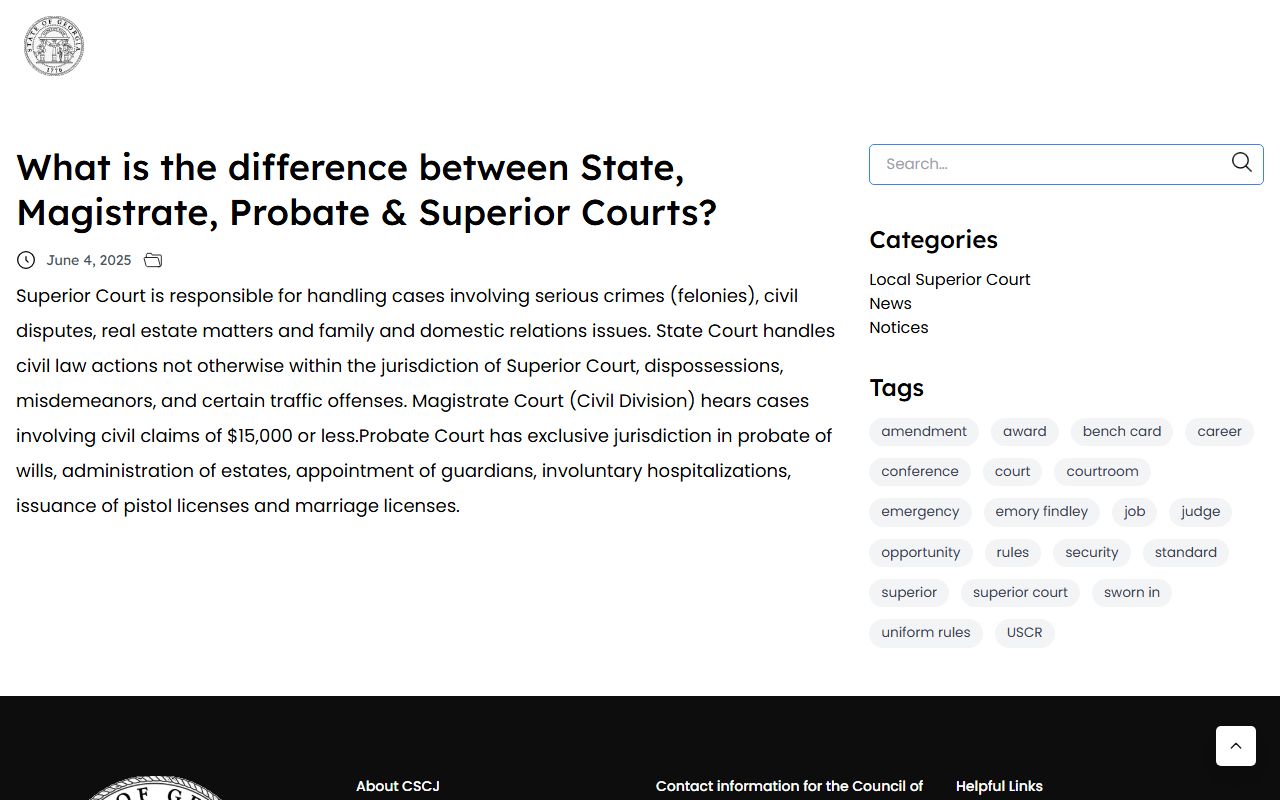
That state-level court structure explains why a felony case, a traffic citation, a probate estate, and a small claim do not all route through the same Glascock County counter.
| Court or Office | Glascock County Role | Records Usually Held |
|---|---|---|
| Superior Court | General trial court in the Toombs Judicial Circuit | Felony, divorce, civil, real estate, family, appeals, judgments |
| Juvenile Court | Locally handled through the Superior/Juvenile clerk | Delinquency, child welfare, juvenile traffic, restricted youth files |
| Probate Court | Limited jurisdiction court in Gibson | Estates, wills, guardianships, vital records, marriage licenses, traffic |
| Magistrate Court | People's court and warrant court | Small claims, dispossessory, garnishment, warrants, bad checks, ordinances |
Start With The Right Office
Glascock County court records are easier to request when the office is chosen by record type. The Clerk of Superior Court is Kristie Stephens, with Deputy Clerk Lisa Haywood. That office keeps Superior and Juvenile Court filings, civil and criminal cases, deeds, plats, liens, judgments, and DD-214 records. The Probate and Magistrate Courts office is led by Judge Johnny Pearson, with Clerk Kristin Daniel, and it handles the probate, traffic, marriage, vital, warrant, misdemeanor, small-claims, garnishment, and dispossessory side.
The county staff directory is also a useful official backup because it lists court, sheriff, jury, transit, and county phone contacts. The Glascock County staff directory should be checked when a department page is thin or when a number needs confirmation.
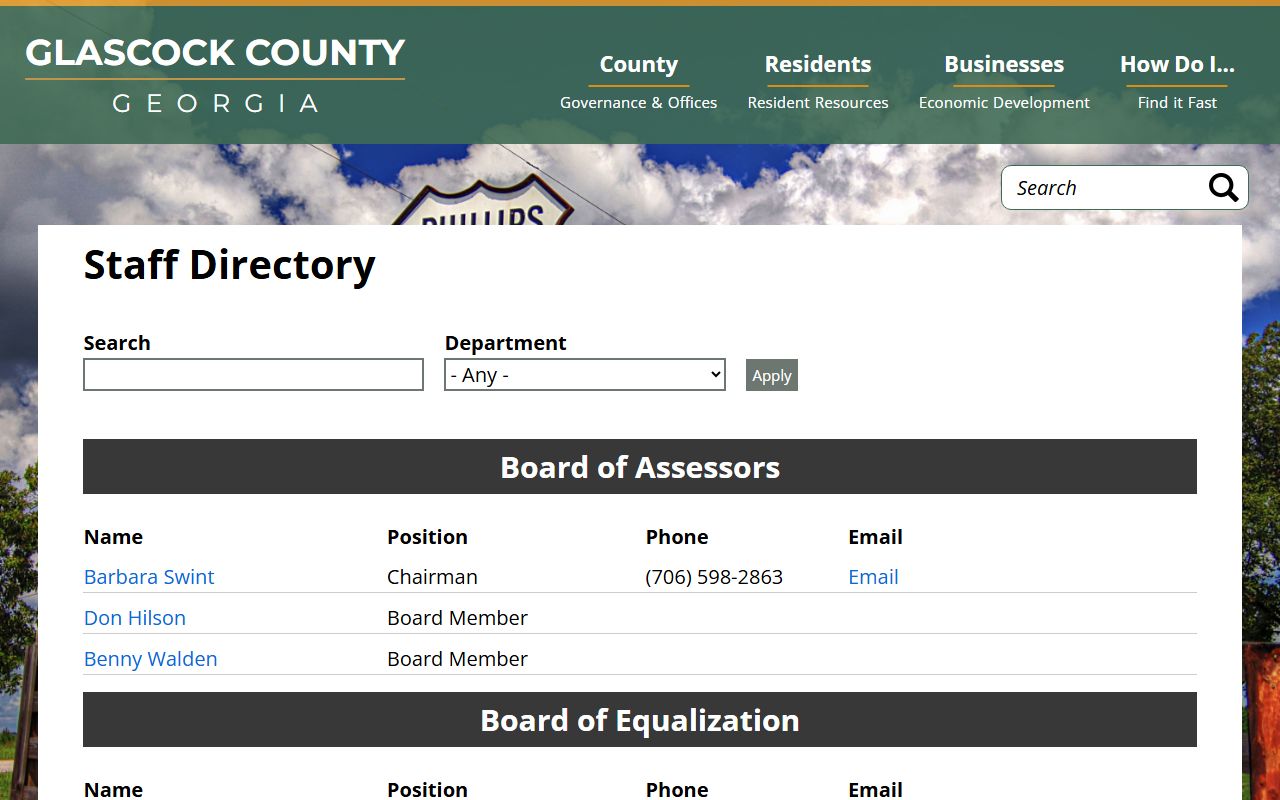
That directory supports the phone-first path for Glascock County records because several official pages provide office functions but not public database links.
Clerk of Superior Court
62 East Main Street
P.O. Box 231
Gibson, GA 30810
706-598-2084
Mon, Tue, Thu, Fri 8:00 a.m.-5:00 p.m.; Wed 8:00 a.m.-12:00 noon
Probate and Magistrate Courts
62 East Main Street
P.O. Box 277
Gibson, GA 30810
706-598-3241
Call before visiting on Wednesdays
Glascock County Sheriff
Official page does not clearly publish a current physical address
Gibson, GA 30810
706-598-2881
Call for custody, booking, and law-enforcement records
Glascock County Court Record Types
Glascock County Superior Court records include civil complaints, answers, motions, orders, judgments, real-property matters, equity, family-law, divorce, felony criminal filings, arraignment entries, plea forms, sentencing sheets, and appeals paperwork. Civil cases must be e-filed through PeachCourt. Criminal files are distinct from sheriff booking records because the court file shows prosecution events and disposition, while the arrest record shows custody and initial charges.
Probate Court records include wills, estates, guardianships, conservatorship-type financial matters, vital-record functions, marriage-license records, firearms-license functions, and traffic citations where the Probate Court has local jurisdiction. Magistrate Court records can include civil claims up to $15,000, small claims, dispossessory cases, garnishments, property foreclosure, abandoned motor vehicles, warrants, bad checks, county ordinance matters, and certain misdemeanor offenses listed by the county page.
- Civil records: pleadings, orders, judgments, motions, service, and appeals entries.
- Criminal records: charges as filed, pleas, bond, hearings, sentence, fines, and disposition.
- Family records: divorce, parenting, support, and sealed or redacted sensitive filings.
- Probate records: estates, wills, letters, guardianship orders, and minute-book entries.
- Traffic records: citations, violation data, court date, payment, contest status, and DDS consequences.
What Glascock County Court Records Show
A Glascock County court record usually starts with a case number or filing identifier, the court name, a caption, parties, attorneys, filing dates, and a list of docket events. Docket means the chronological case log. It may show a complaint, petition, summons, service return, answer, motion, order, hearing notice, continuance, bench warrant, bond order, plea, judgment, sentence, writ, dismissal, or notice of appeal.
Criminal records may add arrest date, charge, statute, felony or misdemeanor class, bond, plea, disposition, probation, restitution, fines, and court costs. Probate records may add decedent, estate number, petitioner, heirs, beneficiaries, will status, letters issued, inventory, annual return, and discharge. Traffic records may show citation number, issuing agency, violation, court date, fine, payment status, and whether the matter may affect a DDS driving history.
| Field | What It Shows |
|---|---|
| Case caption | The parties, estate, ward, defendant, petitioner, or State of Georgia case name. |
| Filing date | When the complaint, petition, accusation, indictment, or citation entered the court file. |
| Docket entry | A dated event such as motion, hearing, order, plea, judgment, or continuance. |
| Disposition | The current or final outcome, such as dismissed, guilty plea, judgment, discharge, or paid citation. |
| Copy status | Whether a public copy, certified copy, redacted copy, or restricted file is available. |
Glascock County Public Access Rules
Georgia's Open Records Act, including O.C.G.A. 50-18-70 through 50-18-72, presumes public records are open unless a statute or exemption applies. For Glascock County, that law is often most useful for sheriff, jail, incident, booking, agency, and administrative records. Court files still must be requested from the court office that keeps the file, and sealed court records are not released just because a public-records request is sent.
Georgia guidance says agencies should respond within three business days. If a record exists but cannot be produced right away, the response should describe the record and give a time and cost estimate. Copy costs may include $0.10 per page and the actual cost of other media. Search and redaction time may be charged after the first fifteen minutes at the lowest-paid qualified employee rate.
Key access rules: O.C.G.A. 50-18-70 covers public access, O.C.G.A. 50-18-71 covers response timing and costs, O.C.G.A. 35-3-37 covers criminal-history record restriction, and O.C.G.A. 42-1-12 supports the GBI sex-offender registry.
Restricted Glascock County Records
Some Glascock County court records are public only in limited form, and some are not routine public files at all. Juvenile records are handled locally through the Superior/Juvenile clerk, but access is restricted by law. Adoption files, mental-health matters, protected medical details, certain victim data, minor identifiers, Social Security numbers, and financial account numbers may be withheld or redacted.
Georgia uses the term record restriction for some criminal-history limits. Georgia Courts and the GBI explain that the process differs for arrests before and after July 1, 2013. Restriction limits non-criminal-justice dissemination, but it does not mean every courthouse, agency, or private copy disappears.
Glascock County Sheriff And Jail
The Glascock County Sheriff's Office is led by Sheriff Jeremy Kelley. The official county page describes the office's public-safety role but does not publish a searchable jail roster, booking-number lookup, mugshot list, active-warrant search, jail visitation schedule, commissary vendor, video visitation provider, or sheriff mobile app. Current custody questions should go through the sheriff phone line.
For state-prison custody, Georgia.gov's Find an Offender service points to the Georgia Department of Corrections search. That is not the same as a county jail roster. The GBI Sex Offender Registry is also separate from jail custody and is based on Georgia registry law.
See the Glascock County inmate records page for custody-specific access and the warrant records page for active-warrant routing.
Glascock County Warrant Records
Glascock County Magistrate Court handles arrest, inspection, and search warrants. No official public active warrant database was located for the Sheriff's Office, Magistrate Court, Probate Court, Superior Court, Gibson, Mitchell, or Edge Hill. That makes the correct phone path important: Magistrate Court for warrant procedure, Sheriff for law-enforcement warrant and custody questions, Superior Court for bench warrants tied to Superior Court cases, and Probate/Magistrate for traffic failure-to-appear issues.
A warrant record, when releasable, may show person name, warrant type, issuing court, judge, warrant or case number, charge or reason, issue date, bond information, agency, court date, and status. Sealed warrants, juvenile matters, active investigations, and safety-sensitive details may be withheld.
Glascock Marriage Divorce Probate
Marriage licenses are issued by Glascock County Probate Court, which also keeps certified and plain copies of marriage licenses and applications for marriages applied for in the county. The statewide Georgia Probate Records marriage application starts with a county dropdown and gives age instructions for applicants.
Divorce records belong to Superior Court, not Probate Court. Divorce files may include complaint, answer, service, parenting plan, settlement, child-support worksheet, temporary order, hearing notice, and final decree. Estate, will, guardianship, vital, firearms-license, and related probate files remain with the Probate Court office in Gibson.
- Probate
- The court process for wills, estates, guardianships, and related administration.
- Executor
- The person named to carry out a will after appointment or recognition by the court.
- Intestate
- Dying without a valid will, which changes how heirs and administration are handled.
- Certified copy
- An official copy bearing clerk certification for legal use.
Glascock Traffic Court Records
Glascock County Probate Court handles misdemeanor traffic citations and game and fish violations. Georgia Courts states that Georgia has no centralized statewide traffic citation database. If a court uses one of the listed solutions, a citation may be searched by name, city or county of issuance, date of birth, or citation number. Citations can take 7 to 21 business days from issuance to become available online.
Traffic court records differ from DDS driving histories. A court traffic record shows the citation, violation, court date, plea or payment, contest status, fine, disposition, and failure-to-appear activity. A Georgia DDS Motor Vehicle Report shows driver-history information after courts report convictions, and it is used for license status, points, suspensions, and certified or non-certified driving history.
Glascock County Record Fees
Official Glascock County sources did not publish a full court-copy fee schedule for every record type. When a local fee is not posted, call the custodian before mailing a request or check. Georgia's open-records guidance supplies a general cost rule for agency records, while GSCCCA and eCertification paths may require account access or subscription fees before the final cost is shown.
| Item | Official Glascock Finding |
|---|---|
| Plain court copy | Fee not located in official Glascock court sources |
| Certified court copy | Fee not located in official Glascock court sources |
| Open-records paper copy | Georgia guidance allows $0.10 per page for agency records |
| Search and redaction time | First 15 minutes free, then lowest-paid qualified employee rate may apply |
| DDS three-year MVR | $7.00 on the researched DDS-18 form |
| DDS seven-year or lifetime MVR | $9.00 on the researched DDS-18 form |
Glascock County Court History
Glascock County was created from Warren County in 1857 and named for Thomas Glascock of Augusta. Gibson became the county seat on land donated by Calvin Logue, and Judge William Gibson donated $500 toward the first courthouse. The New Georgia Encyclopedia says the first courthouse was built in 1858 and served until the newer courthouse opened in 1919.
The New Georgia Encyclopedia gives county history that helps explain why courthouse records matter in Gibson.
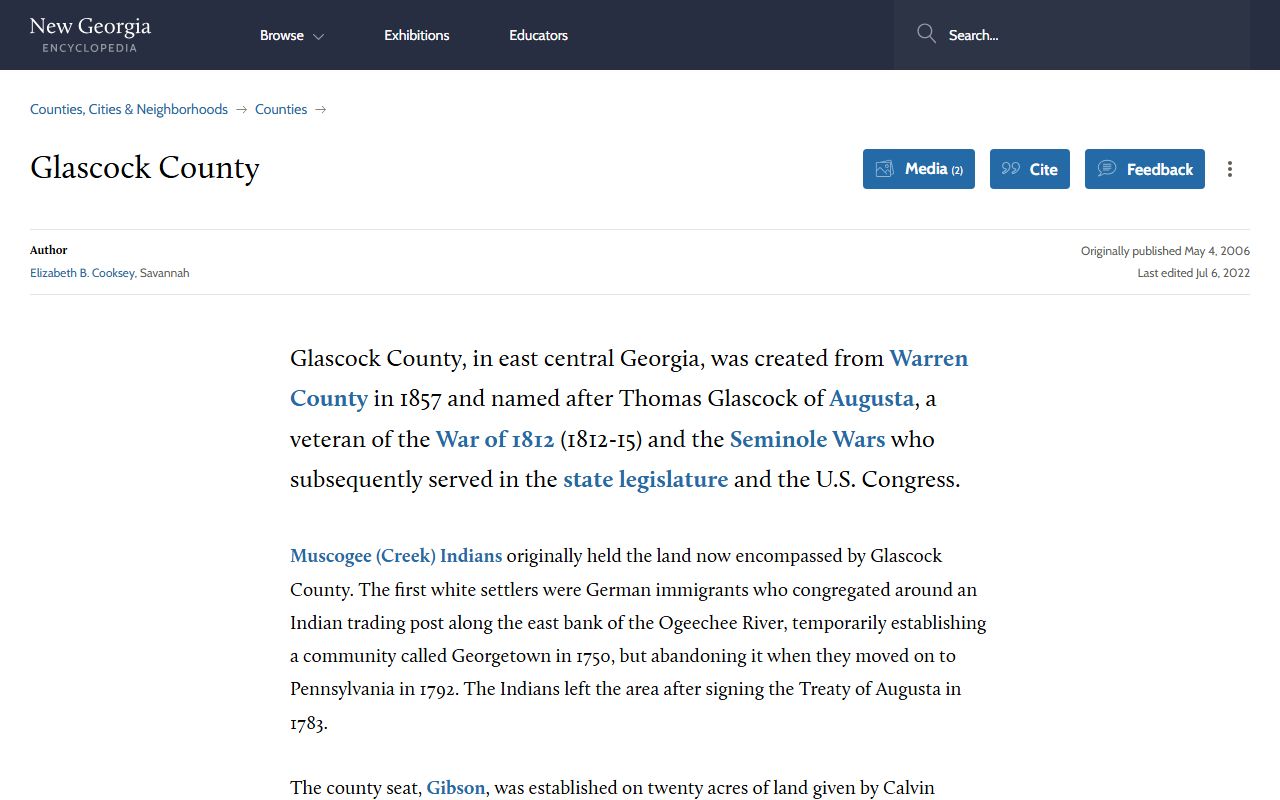
That history connects the modern courthouse records office to land, marriage, probate, and case files that have long been centered in the county seat.
The county courthouse location page lists an official courthouse location in Gibson.
For court counters, the research gives stronger record-specific addresses at 62 East Main Street from the court office pages and GSCCCA directory.
Glascock County Local Context
Glascock County is a small east-central Georgia county with Gibson as county seat. The county homepage lists a P.O. Box in Gibson, the county switchboard, and a county email address. GSCCCA lists county population as 2,700, and the Census QuickFacts source provides a current official demographic reference for Glascock County.
The Census QuickFacts page is a neutral source for county context.
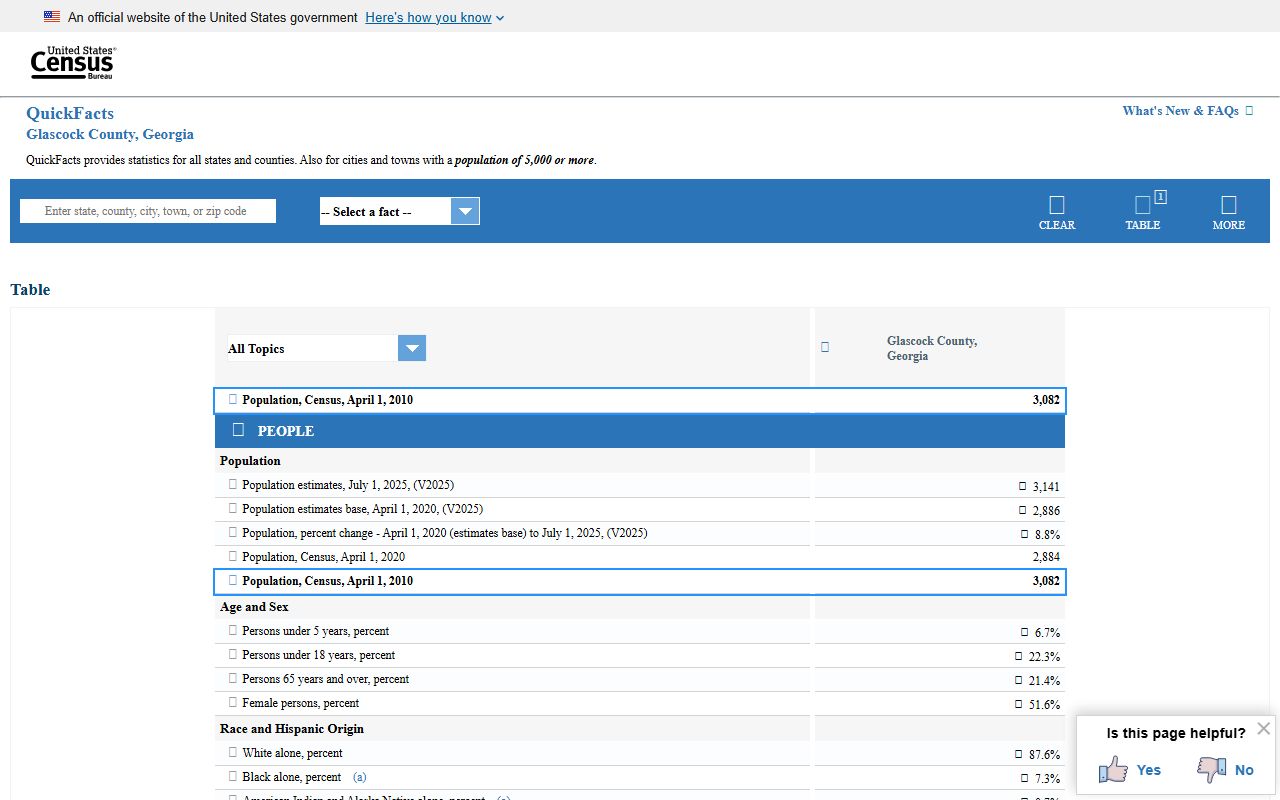
Small-county context matters because official record access is often handled by direct office contact rather than large county portals.
Glascock County Court FAQs
Can I search Glascock County court records online? Not through a county-branded public case portal located in official research. Use GSCCCA for land, lien, UCC, plat, PT-61, notary, and certified-search paths, then call the proper court office for case files.
Which office keeps divorce records? Divorce is a Superior Court matter in Georgia. Request Glascock County divorce files from the Clerk of Superior Court, not the Probate Court.
Where are traffic tickets handled? The Probate Court handles Glascock County misdemeanor traffic citations and game or fish violations. Georgia Courts says there is no one statewide traffic citation database, so contact the court if online payment does not show the ticket.
Is there a Glascock County jail roster? No official online roster was found. Call the Sheriff's Office for current county custody questions, and use Georgia.gov's GDC offender search only for state-prison custody.
How fast must an open-records response come back? Georgia guidance says a response is due within three business days, though production can take longer if records need search, review, redaction, or a cost estimate.